
Written by the team at Fix TV Antenna, who install and repair antennas across Sydney homes and businesses.
If you’ve called around for a few quotes on a new antenna, you’ve probably noticed the numbers don’t line up neatly from one installer to the next. That’s not someone trying to pull a swifty on you. It’s because no two roofs, homes, or suburbs deliver the same signal or present the same challenges. A single-storey brick veneer in Penrith and a two-storey terrace in Paddington are two very different jobs, even with the same antenna or aerial, as some installers still call it, going up.
We get asked “why does it cost what it costs?” fairly often, so here’s an honest look at the TV antenna installation factors that actually shape a TV antenna installation Sydney job, from the roof down to the wall plate in your lounge room. Understanding these before you request a quote means fewer surprises and a clearer conversation with whoever you hire.
In short: what a TV antenna installation costs in Sydney comes down to a combination of factors, including:
- Your property type: house, townhouse, apartment, or commercial premises
- Roof access, pitch, and roofing material
- Local signal strength and terrain
- The condition of your existing cabling
- Any extra work, such as additional TV points, a booster, or wall mounting
- Recent storm or weather damage
Most experienced technicians run through this same list mentally within the first few minutes of arriving on site, checking each factor before a single cable gets touched. We’ll go through each one below.
Why No Two Homes Are the Same
No two antenna jobs cost the same, and it’s not because pricing is inconsistent. What affects TV antenna installation costs at each property comes down to three things: mainly roof type, signal strength, and cabling condition, and those alone determine how much access, equipment, and labour a job needs. A single-storey home with a clean signal and modern cabling is a very different job to a two-storey house sitting in a weaker signal pocket with degraded cable. That’s why a fair quote is built around an assessment of your specific property, not a flat rate applied across the board.
Every antenna installation starts with the same basic question: what’s the safest, most reliable way to get a clean signal to every TV point in the house? The answer shifts depending on where the house sits, what it’s built from, how old the wiring is, and even which way the roof faces relative to the nearest transmission tower.
Interestingly, the first thing a technician usually does isn’t climb the ladder. It’s check the signal at a TV point inside the house, to work out whether the problem is actually on the roof, or somewhere in between. A weak reading at the wall plate but a strong one at the antenna lead points to the cabling. A weak reading at both points back to the roof. Skipping that step and heading straight up the ladder is how avoidable callbacks happen.
It’s not unusual for us to see homes on the same street, sometimes even next door to one another, that need completely different setups. One might be a straightforward eave-mounted antenna job. The next might call for a taller mast and a higher-gain unit just to get past some tree cover and a neighbouring two-storey blocking the line of sight. Multiply that by Sydney’s mix of housing stock, Federation cottages, 1970s brick homes, glass-heavy new builds, high-rise apartments, and it’s easy to see why a proper quote usually follows a conversation about your specific property, not a flat figure pulled off a price list.
The starting point for most of that variation comes down to one thing: what kind of property you actually live in.
Property Type
What kind of property you live in probably has more say in the quote than anything else on this list. Single-storey homes, double-storey homes, townhouses, apartments, and commercial buildings all need different roof access, mast heights, and approval processes, so the category your place falls into tends to set the tone for the whole job. Standalone houses are usually the simplest installs, while apartments and townhouses often come with a shared antenna system or strata sign-off to sort out first.
| Property Type | Roof & Mast Access | What Usually Changes |
| Single-storey home | Straightforward; shorter mast and cable runs | Generally the most straightforward installation |
| Double-storey home | Needs a taller mast or extension pole to clear the ridge line | Trickier access; safety gear becomes essential |
| Townhouse | May share walls or roof space with neighbours | Owners corporation (“body corporate”) rules can apply |
| Apartment | Often connects into a shared MATV system rather than a standalone antenna | Building approval is usually required first |
| Commercial building | Larger roof, often several TV points | Distribution amplifiers add to the scope of work |
One quick giveaway a technician looks for in apartments: a distribution box or amplifier already sitting in a riser cupboard on your floor, rather than a lead running straight up to a rooftop antenna. That’s usually a sign you’re on a shared MATV (Master Antenna TV) system rather than a standalone connection.
But regardless of property type, there’s one factor that shapes almost every quote before anything else gets considered: getting onto the roof in the first place.
Roof Access
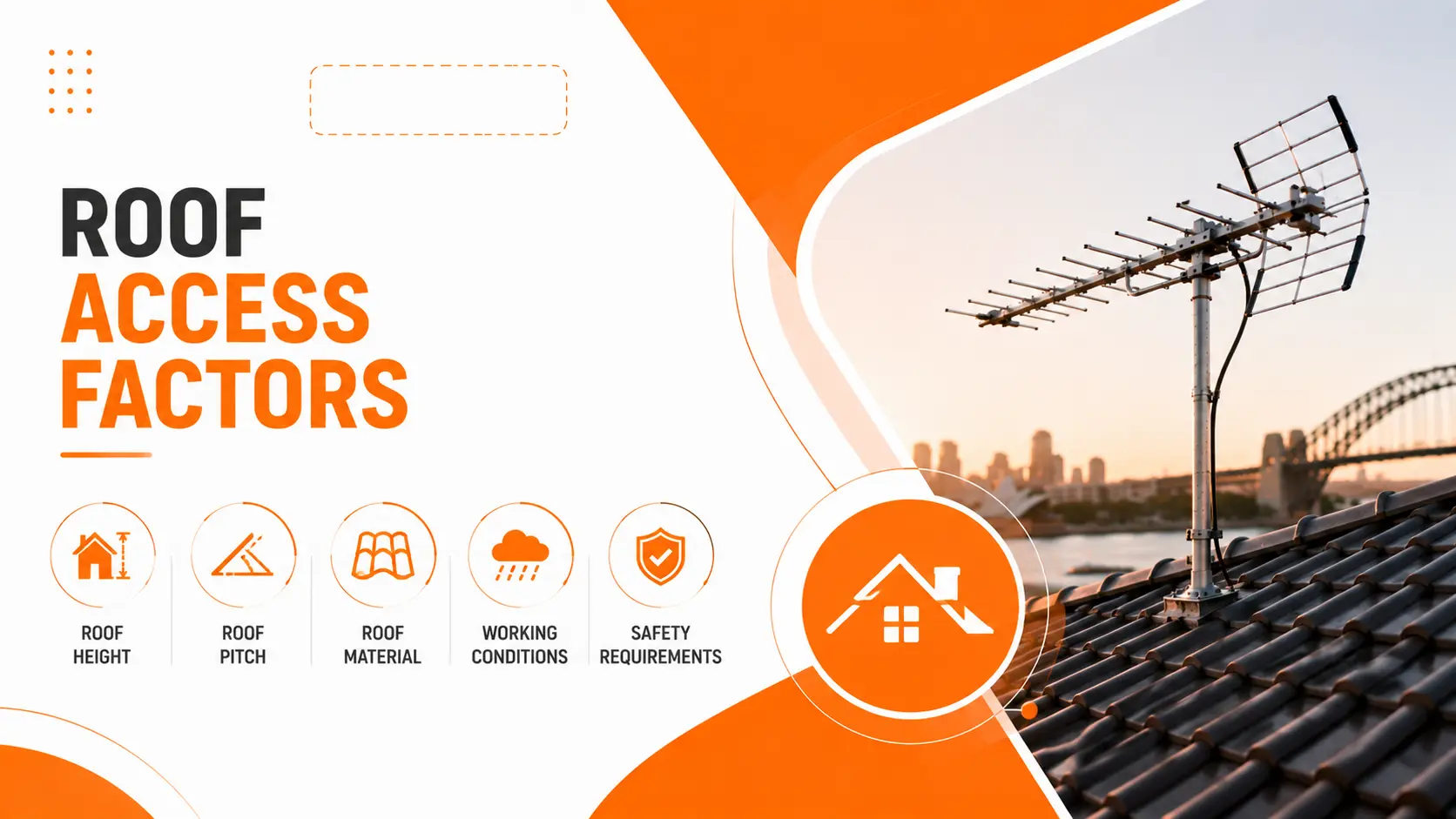
Getting onto the roof safely, before a single screw goes in, is one of the biggest cost drivers in any roof antenna installation, and one of the least visible to the person standing on the ground looking up. Roof height, pitch, and material all determine how safely and quickly a technician can get up there, move around, and mount the antenna and mast, and each one adds its own time and safety requirements to the job.
| Roof Factor | What It Affects |
| Roof height | How much ladder, extension pole, or anchoring is needed |
| Roof pitch | How safely and quickly a technician can move around |
| Roof material | Footing, mounting method, and handling care required |
| Working conditions | Time and complexity added by wind, trees, or tight access |
| Safety requirements | Harnesses, anchor points, and insurance considerations |
Roof height determines how much ladder, extension pole, and sometimes additional anchoring a job needs.
Roof pitch changes how safely and quickly a technician can move around. A gentle tile roof is far easier to work on than a steep Federation-era roof, or one with mixed pitches across different sections. Before stepping onto any roof, an experienced installer is really weighing up three things: is it wet or likely to get slippery, is the pitch manageable without extra harness anchor points, and is there a stable, safe spot to actually stand and work, not just walk across the ridge capping.
Roof materials change the approach entirely. Terracotta and concrete tiles need careful footing to avoid cracking, Colorbond and metal roofing can turn slippery in any moisture, and older asbestos-cement roofing, still common on Sydney homes built before the 1980s, needs specific handling in line with current asbestos safety regulations.
Working conditions, including wind exposure, nearby power lines, overhanging trees, or a roof hemmed in by a neighbouring wall, all add time and complexity to the job. One detail homeowners rarely think about: if new cable needs to be run through the roof space rather than along an existing path, the entry point needs to be properly sealed, otherwise you’ve traded a reception problem for a slow leak.
Safety considerations aren’t a box-ticking exercise. Work health and safety regulations, enforced in this state by SafeWork NSW, require fall protection for most roof work, which is exactly why harnesses and roof anchor points aren’t negotiable, no matter how experienced the installer is. A properly insured technician builds all of this into how they plan and price a job.
Even with perfect roof access, none of it counts for much if the signal reaching that roof isn’t strong enough to begin with.
Signal Strength
Some parts of Sydney simply pull in a weaker signal than others, and when that’s the case, you’re often looking at a higher-gain antenna, a booster, or both, just to get a reliable picture. Free-to-air TV here is broadcast as digital terrestrial television on the UHF band, and how strongly that signal reaches your roof depends on distance from the transmission tower, terrain, and what’s standing in the way: hills, trees, other buildings. Sydney’s signal strength varies considerably from suburb to suburb, which is why the same antenna model can perform very differently on two properties just a few streets apart.
Here’s something most homeowners don’t realise: a technician isn’t just checking how strong a signal is, they’re checking how clean it is too. A signal can read as “strong” on a meter but still be noisy or full of interference, especially in areas surrounded by tall buildings, where the same broadcast can bounce off several surfaces and arrive at your antenna slightly out of sync with itself. That’s called multipath, and it’s a common cause of intermittent dropouts in denser parts of Sydney, even where raw signal strength looks fine on paper.
| Term | What It Means |
| Signal strength | How much signal power is reaching the antenna |
| Signal quality | How clean and usable that signal is once interference, like multipath, is factored in |
Since Australia completed its transition from analog to digital terrestrial broadcasting in 2013, reception problems tend to show up differently than they used to. Digital TV doesn’t fade out gradually the way analog signals did. It tends to work perfectly right up until the signal drops below a certain threshold, and then it starts freezing, pixelating, or cutting out altogether. This is often why a picture that was fine for years can suddenly start playing up even though nothing at your place has physically changed. A tree’s grown taller over a season, a new building’s gone up nearby, or atmospheric conditions on a given day have shifted the signal just enough to tip it over that edge.
Local signal strength generally comes down to:
- Distance from the nearest transmission tower
- Terrain, hills, valleys, or ridgelines between the property and the tower
- Tree cover and vegetation growth over time
- Nearby tall buildings or dense development
Suburbs closer to the main transmission towers around Kings Cross or Artarmon generally receive stronger signal, while areas further out, or sitting in valleys, behind ridgelines, or under dense tree cover, often need a higher-gain antenna or extra support like a booster to get a clean picture.
Getting a strong, clean signal onto the roof is only half the story; what happens to it once it enters the house depends entirely on what’s already running through your walls.
Existing Cabling
Old coaxial cable, a damaged wall plate, or a poorly matched splitter can cause poor reception even when a brand-new antenna is doing its job perfectly, which is exactly why existing cabling has such a say in the final cost. Cabling condition matters every bit as much on upgrades as it does on first-time installations, since problems hidden inside the walls are rarely visible from the lounge room. In Australia, cabling work is governed by rules that cablers registered with the Australian Communications and Media Authority (ACMA) are required to follow, which is one reason getting the diagnosis right matters more than simply swapping the antenna and hoping for the best.
In our experience, a lot of reception complaints that homeowners assume are an antenna problem actually come down to something much simpler: a loose or corroded F-connector, the small screw-on fitting joining the cable to the wall plate or splitter. It’s an easy thing to overlook, and an easy thing to fix, which is exactly why a technician will usually check every connector in the chain before assuming the antenna itself is faulty.
| Cabling Issue | Typical Symptom |
| Old or degraded coaxial cable | Dropouts or pixelation, even with a good antenna |
| Damaged or cracked wall plate | Weak or inconsistent signal at that point |
| Cheap, unpowered splitters | Weak signal spread across multiple TVs |
| Leftover DIY wiring | Reception that’s inconsistent between rooms |
Old coaxial cable typically RG6 in Australian homes, particularly anything more than fifteen or twenty years old, often has degraded shielding, which shows up as dropouts or pixelation even when the antenna itself is working perfectly fine. It usually needs replacing rather than reusing.
Damaged wall plates are more common than you’d think, especially in homes that have been renovated or repainted a few times, and a cracked or corroded plate can introduce enough signal loss to affect reception.
Splitters feeding multiple TVs off one cable run are a frequent culprit for weak or patchy signal. Every time a signal is split to feed another point, some of it is lost, that’s simply how splitting works, not a fault in itself but it becomes a real problem when cheap, unpowered splitters are used on a system with several TVs, because there’s nothing to make up for that loss.
Previous DIY work, a rushed wall plate swap, a cable run without proper connectors, or an antenna “adjusted” by hand after a storm, often needs to be undone before a new installation can perform the way it’s meant to.
None of this automatically means a full rewire. Sometimes the existing cabling’s perfectly fine, and it’s the extras you’re adding that shape the final scope of work.
Additional Services
This is where quotes tend to vary the most between properties, because the scope of a job often grows well beyond “just” putting up an antenna. Extra TV points, a signal booster, wall mounting, or a full cable replacement can all be bolted onto the base job, and each one adds its own labour, materials, and time. A good TV antenna installer Sydney homeowners rely on will usually ask about these upfront, rather than treating them as an afterthought once they’re already on the roof.
| Additional Service | What It Adds |
| Extra TV points | New cable runs and wall plates |
| Signal booster | Amplification for long cable runs or multiple splits |
| Wall mounting | Cable concealment inside the wall cavity |
| Cable replacement | A full rewire, rather than just the antenna lead |
Extra TV points for a second bedroom, home office, or outdoor entertaining area add cable runs and wall plates to the job.
Signal boosters (also called masthead amplifiers) compensate for cable length, multiple splits, or a naturally weaker signal area. A proper signal booster installation makes a real difference where distance or splitting has thinned out the signal. Worth knowing: a booster amplifies whatever it’s given, noise included. If the raw signal reaching the antenna is genuinely poor rather than just thinned out, a booster on its own won’t fix it. It’ll just make a weak, noisy signal louder. That’s why a technician checks signal quality before recommending one, rather than defaulting to it as a catch-all fix.
Wall mounting your TV alongside the antenna work often means concealing cables inside the wall cavity, which takes longer than a simple points-and-plate job.
Cable replacement throughout the house is a bigger undertaking than replacing just the antenna lead, but it usually resolves reception issues for good, rather than patching them temporarily.
If you’re planning any of this alongside your main installation, mention it upfront. Bundling the work is almost always more efficient than calling someone back out later. Have a look at our extra TV points page if you’re thinking about wiring up more than one room.
Extras are one thing you can plan for in advance. Sydney’s weather is another matter entirely.
Storm Damage
Wind, rain, and lightning can bend a mast, loosen a bracket, or corrode a connector without leaving any obvious sign from the ground, and that’s exactly why storm damage shows up so often in antenna installation and repair costs across Sydney. Our storm season is especially hard on rooftop antennas, and coastal salt air adds a further layer of corrosion risk to metal fittings. Sorting out storm damage early is usually a lot simpler than waiting for the whole system to fail, since a small mechanical fault can quietly turn into total signal loss over a few weeks.
After a storm, the first things a technician checks usually aren’t the antenna elements themselves. It’s the mounting bracket bolts, the mast clamp, and the connector at the base of the mast, since that’s typically where movement or water ingress does the most damage. A slightly bent element rarely causes total signal loss on its own, but a bracket that’s worked loose can slowly rotate the whole antenna off alignment over weeks, which is why reception sometimes gets progressively worse after a storm rather than failing all at once.
Salt air along the coastal suburbs speeds up corrosion on brackets, clamps, and connectors too, which is why antennas closer to the coast often need earlier attention than those further inland. The damage isn’t always obvious from the ground, either. A mast can look fine from the backyard while a bracket has actually worked loose or a connector’s started letting moisture in. If your picture drops out after every burst of wild weather, it’s usually not a coincidence, and it’s worth getting it looked at before a fixable problem turns into a full TV antenna repair job.
So how do you know if a storm’s caused damage? A few common giveaways:
- Picture dropping out or freezing during or after wind and rain
- A mast that looks bent, twisted, or off-alignment from the ground
- Reception that gradually worsens over several days, rather than failing all at once
- Static or interference that comes and goes with the weather
- Visible corrosion on brackets, clamps, or connectors, particularly in coastal areas
Whether it’s storm damage, ageing cable, or simply wanting better reception, much the same advice applies before you book anyone in.
Expert Tips Before Requesting a Quote
Before requesting a TV antenna installation quote, it helps to note any existing reception issues, mention recent renovations, and confirm exactly what the quote covers. Giving an installer this information upfront allows them to scope the job accurately and reduces the chance of unexpected costs once work begins. Homeowners who prepare a few key details in advance typically get a faster, more accurate quote.
- Note which rooms need a signal. Knowing how many TV points you actually want helps an installer scope the job accurately from the first conversation.
- Mention any recent renovations. New roofing, insulation, or an extra storey can all change what’s needed compared with your last installation.
- Flag any reception issues already happening, even minor ones — pixelation on certain channels, dropouts in bad weather, or a picture that’s fine on some TVs but not others. These details speed up diagnosis.
- Ask whether the quote covers cable and wall plate condition, not just the antenna itself. A cheap-looking quote that skips over ageing cable can end up costing more once the real problem surfaces.
- Check the installer is licensed and insured for working at heights. This protects you as the homeowner if anything goes wrong on the roof.
- Be upfront about apartment or townhouse restrictions, including owners corporation or strata rules, so the installer can plan around them rather than discover them on the day.
- If you can, take a quick photo of your roof and existing antenna from the ground. It gives a technician a rough sense of the roof type and current setup before they even arrive, which often makes the on-site assessment quicker.
It’s also worth checking whether the problem affects one TV or the whole house before you call — it’s a quick way to narrow down the likely cause:
| Symptom | Likely Cause |
| Only one TV has poor reception | That TV’s cable run, wall plate, or a nearby splitter |
| Every TV in the house has poor reception | The antenna itself or the signal reaching the roof |
A reliable TV antenna installer Sydney homeowners can trust will usually ask most of these questions themselves, but going in prepared makes for a smoother, more accurate quote either way.
Frequently Asked Questions
These are some of the questions Sydney homeowners ask us most often about TV antenna installation costs, signal issues, and property-specific requirements. Each answer reflects the same factors technicians assess on site: property type, roof access, signal strength, and cabling condition.