
If your TV picture keeps dropping out, pixelating or turning into a blocky mess whenever the wind picks up, you might be wondering whether the antenna needs a repair or whether it’s simply getting too old.
As a general rule, repair your TV antenna when the problem is limited to cabling, alignment or an individual component. Replacement is usually the better option when there’s significant rust, structural damage, widespread corrosion, repeated faults or an outdated antenna.
There’s no hard-and-fast rule based on age alone. Two antennas installed in the same year, even on the same street, can end up in very different condition. The quality of the original installation, the materials used and exposure to Sydney’s weather all make a difference.
Here’s what to look for before deciding whether your antenna needs a repair or a complete replacement.
How Long Does a TV Antenna Last?
Most quality TV antennas last around 10–15 years, although a well-installed antenna can sometimes last longer.
A few things can affect how long your antenna lasts:
- Antenna material
- Quality of the original installation
- Roof and mounting condition
- Exposure to strong winds and storms
- Salt-air exposure
- Corrosion
- Condition of cables and other components
Aluminium antennas generally cope better with corrosion than painted steel models once the protective coating starts to wear away.
Where you live matters, too. Antennas around exposed coastal areas such as Cronulla, Manly and parts of the Northern Beaches can deteriorate faster because of salt air. A similar installation further inland may last considerably longer.
But don’t assume an old antenna automatically needs replacing. A properly installed antenna on a solid mount can keep working beyond 15 years. If you’re replacing an old system, professional TV Antenna Installation can also help ensure the new antenna is correctly positioned and secured. On the other hand, poor mounting or unsuitable brackets can cause problems much earlier.
Signs Your TV Antenna Can Be Repaired
Your TV antenna may only need repair when the main antenna and mounting structure are still in good condition and the fault is limited to a cable, connection or individual component.
Common repairable problems include issues that are typically handled through TV Antenna Repairs, such as:
- Loose or degraded coaxial cables
- Slight antenna misalignment
- Faulty wall plates
- Worn or unsuitable splitters
- Minor storm damage
- Individual damaged components
Loose or Degraded Cables:
Coaxial cables and their connections can loosen or deteriorate over time. This is particularly common where cables run through roof spaces or have been disturbed during other building or electrical work.
A poor connection can look like a failing antenna, which is why TV Antenna Repairs should start with checking the entire signal path rather than replacing the antenna straight away.
- Picture dropouts
- Pixelation
- Missing channels
- Intermittent reception
If the picture cuts out when the TV unit or wall connection is moved, the connection itself is worth checking before blaming the antenna.
Misalignment:
A strong storm or a run of heavy winds can move an antenna slightly from its original position.
That small movement can be enough to affect certain channels. You might lose one network while others continue working normally because different networks use different frequencies.
If that’s happening, the antenna may simply need realigning rather than replacing.
Faulty Wall Plates:
The wall plate behind the TV can become a weak point, particularly in older homes. Internal connections can loosen or corrode, affecting the signal before it reaches the television.
Testing the signal at another accessible point can help show whether the problem is between the antenna and the TV outlet.
Worn Splitters:
A splitter divides the signal between multiple TVs. Every additional connection introduces some signal loss.
That’s rarely an issue when the incoming signal is strong. On a weaker signal, though, an old splitter or one feeding more outlets than necessary can push reception over the edge.
Sometimes simplifying the distribution system is all that’s needed.
Minor Storm Damage:
A bent element doesn’t automatically mean the whole antenna has to come down.
If the main boom and frame are still straight and structurally sound, individual damaged parts may be repairable. A split boom, badly twisted frame or damaged mounting structure is another matter and may make replacement the safer option.
Signs Your TV Antenna May Need Replacing
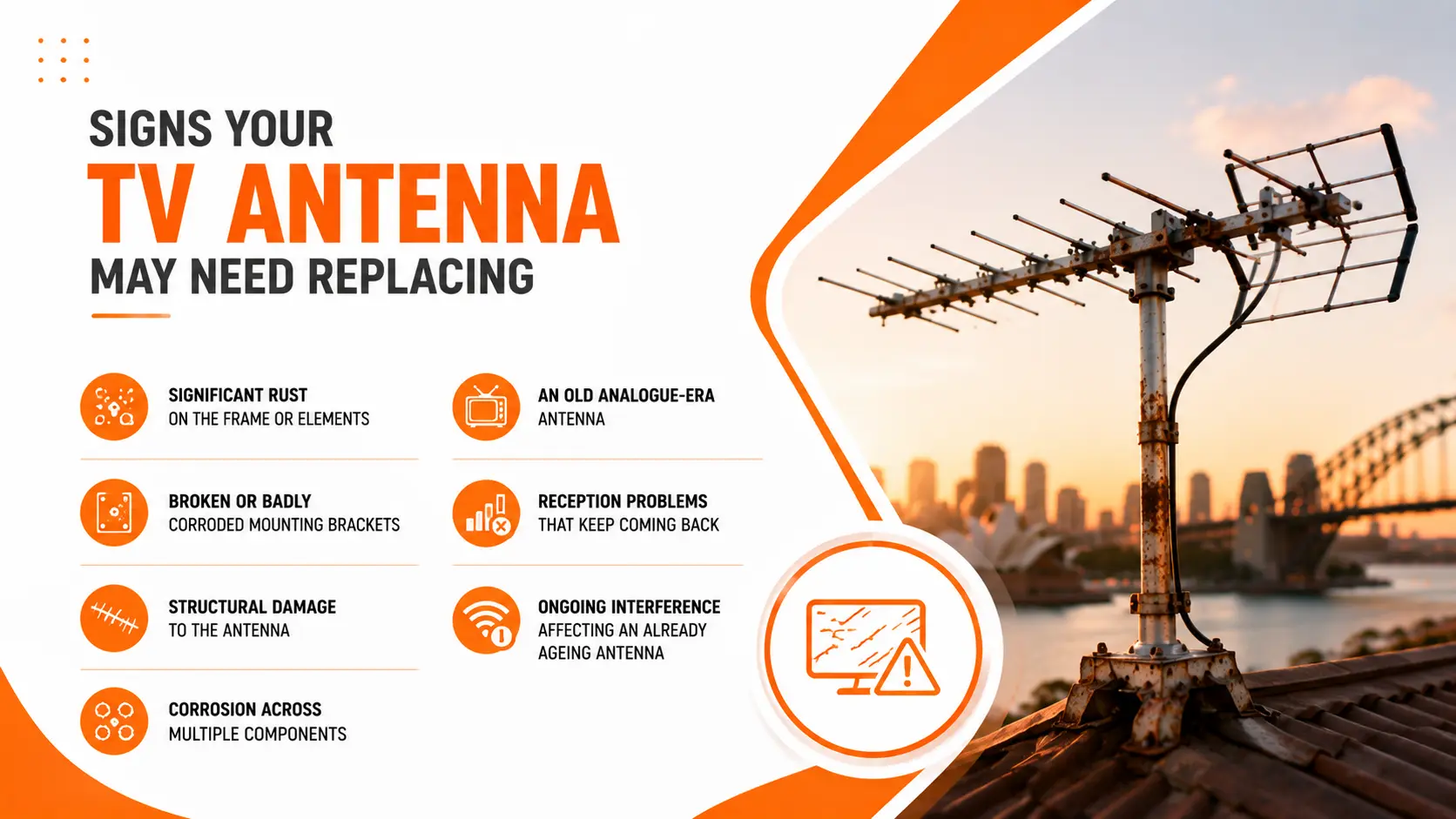
An antenna is more likely to need replacement when it has structural damage, widespread corrosion, badly damaged mounting hardware, repeated faults or is an outdated model.
Keep an eye out for:
- Significant rust on the frame or elements
- Broken or badly corroded mounting brackets
- Structural damage to the antenna
- Corrosion across multiple components
- An old analogue-era antenna
- Reception problems that keep coming back
- Ongoing interference affecting an already ageing antenna
Rust on the Frame or Elements:
A little surface rust isn’t necessarily a reason to replace an antenna straight away.
Structural corrosion is the bigger concern.
If the metal is badly pitted, flaking or starting to break down, the problem won’t disappear just because one component has been repaired. Corrosion can continue weakening the antenna over time.
Broken or Corroded Mounting Brackets:
A damaged bracket isn’t just a reception problem. It can become a safety issue as well.
The tricky part is that a weakened bracket isn’t always obvious from the ground. There may be movement or corrosion that only becomes apparent during a proper inspection.
If the mounting structure can no longer hold the antenna securely, replacement is generally the safer long-term choice.
Old Analogue-Era Antennas:
Antennas installed before Australia’s digital switchover in 2013 may have been designed around an older broadcast setup.
Some older models have a wider, boxier configuration designed to handle VHF as well as UHF signals. Newer antennas may be designed more specifically around today’s UHF broadcasts.
An older antenna can still work, so age alone isn’t enough to condemn it. Its physical condition and actual signal performance need to be considered as well.
Corrosion Throughout the Components:
Corrosion doesn’t always start on the obvious parts.
Connectors, the boom and other components can deteriorate too. Green or white powdery deposits around connections can be an early warning sign.
If corrosion is appearing throughout the system rather than on one easily replaced part, replacement may make more sense than continuing with individual repairs.
Repeated Reception Problems:
If you’ve already had the same reception problem repaired several times, it’s worth looking at the bigger picture.
Repeated faults can be a sign that the antenna or another major component is simply reaching the end of its useful life.
What About 5G Interference?
Some older antenna systems can also be affected by interference from newer mobile network infrastructure.
You may notice:
- Blocky pictures
- Intermittent dropouts
- Unstable reception
An appropriate filter can sometimes deal with the interference without replacing the antenna. If the antenna is already old or deteriorated, though, replacement may be the more sensible long-term fix.
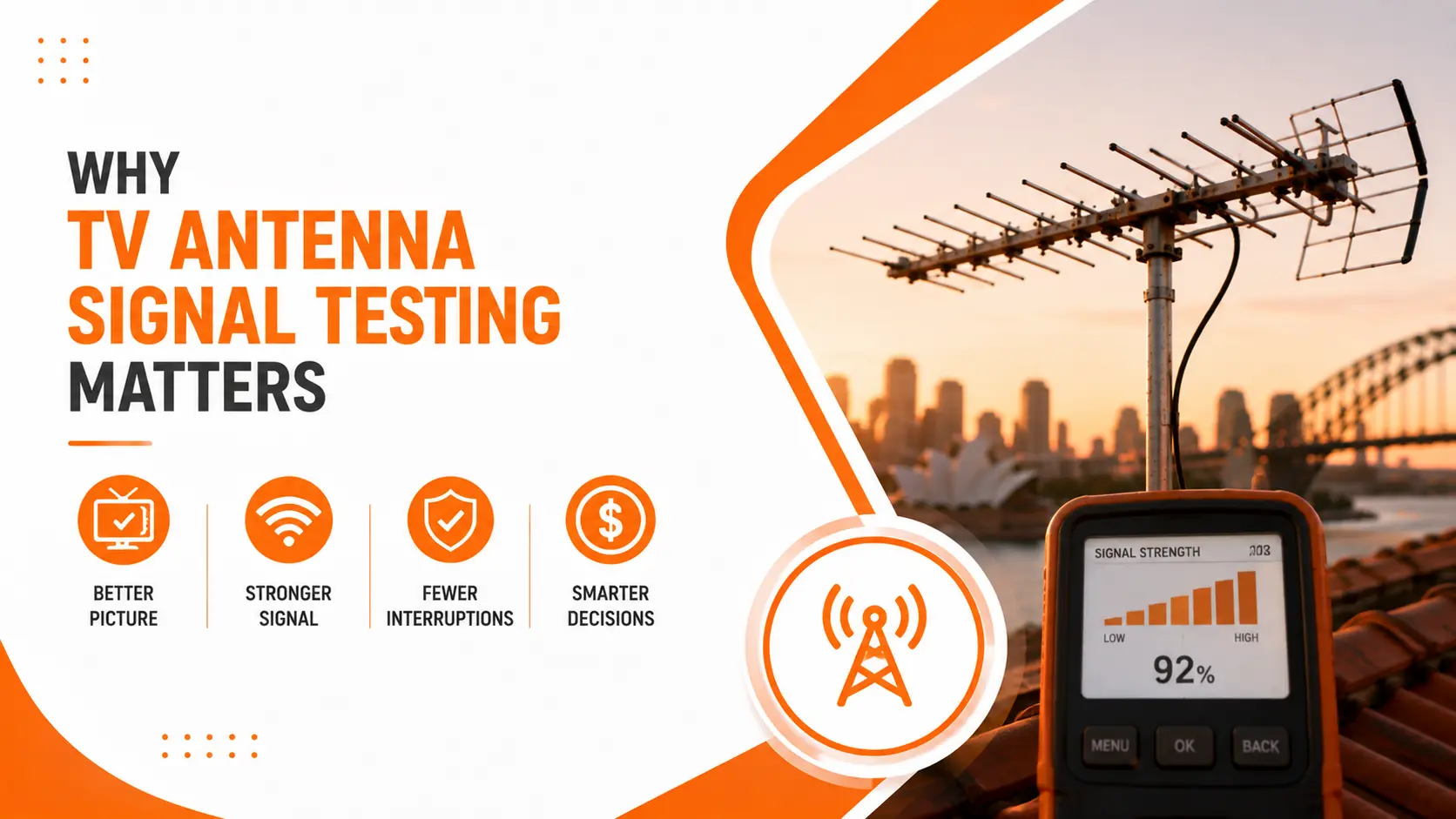
Why TV Antenna Signal Testing Matters
A proper TV antenna test checks both signal strength and signal quality at the TV point. This helps identify whether the problem is coming from the antenna, cabling, splitter, wall plate or another part of the system.
A strong signal doesn’t necessarily mean good reception.
You can have plenty of signal strength but poor signal quality because of interference, cable problems or other faults. A weaker signal can also work perfectly well if it’s clean and stable.
What Is MER in TV Antenna Testing?
MER (Modulation Error Ratio) is a measurement of digital signal quality. It helps show whether the received TV signal is clean enough for the television to decode reliably.
That’s why checking signal strength at the antenna isn’t the whole story.
The signal still has to travel through cables, splitters and wall plates before it reaches your TV. Problems along that path can affect what you actually see on screen.
What Does a TV Antenna Signal Test Check?
A proper assessment should include:
- Visual inspection of the antenna, frame and mounting brackets.
- Signal strength testing at the TV point.
- Signal quality testing, including MER where appropriate.
- Cable inspection to identify damaged or degraded connections.
- Splitter and wall plate checks for unnecessary signal loss.
- Fault tracing from the TV point back towards the antenna.
Testing at the actual TV outlet matters because a good reading on the roof doesn’t necessarily mean the television is receiving a clean signal.
TV Antenna Repair vs Replacement
Once the system has been checked, the decision usually comes down to the condition of the antenna, mounting hardware and individual components.
| Factor | Repair | Replacement |
| Best for | Cabling, alignment or individual component faults | Rust, corrosion, structural damage or repeated faults |
| Upfront cost | Usually lower | Usually higher |
| Longevity | Extends the life of a sound antenna | Starts with a new antenna system |
| Performance | Resolves faults caused by individual components | Can improve performance when an old system is deteriorating |
| Suitable when | Frame and mounting structure are sound | Antenna or mounting structure is badly deteriorated |
Quick Rule: Repair or Replace?
Choose repair when:
- The antenna frame is structurally sound
- The mounting bracket is secure
- The problem is caused by cabling
- The antenna is slightly misaligned
- A wall plate or splitter is faulty
- Storm damage is minor
Choose replacement when:
- The antenna has significant rust
- The mounting bracket is badly corroded or damaged
- The frame or boom is structurally compromised
- Corrosion affects multiple components
- The antenna is very old
- Reception problems keep returning after repairs
In simple terms, if the antenna and mounting structure are sound, repair is often enough. If the structure is deteriorated or keeps failing, replacement is usually the better long-term option.
The condition of the actual system matters more than its age on paper. What works perfectly well on one roof may not be the right solution for another.
Common TV Antenna Mistakes Homeowners Make
Assuming the Antenna Is Always the Problem
Not every reception issue starts with the antenna.
Cables, splitters, wall plates and other components can cause exactly the same symptoms. Replacing the antenna without finding the actual fault may leave you with the same problem.
Climbing Onto the Roof for a DIY Fix
Roof work isn’t something to take lightly, particularly on steep or older roofs.
After a storm, there’s another problem: the roof may still be wet or unstable. Trying to fix the antenna yourself in those conditions can turn a minor reception problem into a much bigger one.
Ignoring Minor Storm Damage
A slightly moved antenna or bent element might not cause obvious problems straight away.
Leave it unchecked, though, and the next bout of strong wind can make things worse.
Choosing a Replacement Without Checking Suitability
There isn’t one antenna that suits every property.
For example, a high-gain directional antenna can work well where the signal is coming strongly from one direction. In built-up areas with reflections and surrounding buildings, a different antenna design may provide more consistent results.
The right choice depends on the property’s signal conditions, not simply the antenna with the highest gain.
Skipping a Proper Signal Test
Without testing, it’s easy to replace something that wasn’t actually faulty or miss the real cause of the problem altogether.
A proper signal test gives you something much more useful than a guess based on what’s happening on screen.
Final Takeaway
A bad TV picture doesn’t automatically mean you need a new antenna.
If the antenna and its mounting structure are still in good condition, the problem may be something as simple as a loose cable, poor alignment, faulty wall plate, worn splitter or minor storm damage.
Replacement becomes more sensible when you’re dealing with significant rust, structural damage, widespread corrosion, repeated faults or an outdated antenna system.
The sensible place to start is with a proper inspection and signal test. Once you know what’s actually causing the problem, it’s much easier to decide whether the antenna needs fixing or whether it’s time to replace it.