

Ask five Sydney homeowners what they paid for their antenna installation, and you’ll probably get five different numbers. It’s not that anyone’s being cagey about pricing; no two antenna jobs are really the same job.
A two-storey Federation home in Hunters Hill with a steep tiled roof is a world away from a single-storey brick veneer in Blacktown with easy roof access and a clean line of sight to the transmission towers.
So if you’re trying to work out how much TV antenna installation costs in Sydney, here’s the honest version: it comes down to your property, what’s already up there, and what you actually need done.
This guide walks through the factors that move the price up or down, explains what’s really going on when your reception starts playing up, and gives you the questions worth asking before anyone climbs a ladder.
Table of Contents
- Why There Isn’t a Fixed Price for Every TV Antenna Installation
- What Factors Affect TV Antenna Installation Costs?
- New Installation vs Replacing an Existing Antenna
- Can an Existing TV Antenna Be Repaired Instead?
- What’s Usually Included in a Professional Installation?
- How to Get an Accurate Quote
- Common Mistakes Homeowners Make
- Frequently Asked Questions
Why There Isn’t a Fixed Price for Every TV Antenna Installation
Quick answer: TV antenna installation cost in Sydney depends on your property type, roof access, the condition of any existing antenna and cabling, local signal quality, and any extras like a signal booster or additional TV points.
Two homes on the same street, both after a standard digital terrestrial television setup, can still land on very different quotes once an installer’s actually had a look at each roof.
We get asked for a “ballpark figure” almost every day, and the answer never really changes: it depends what we find once we’re on site. An antenna that’s been up since the analogue days, corroded cabling snaking through the roof cavity, and a chimney blocking the line of sight to Artarmon or Gore Hill add up to a bigger job than a newer build with tidy cabling and an easy roof to work on.
Digital signal doesn’t fade gracefully the way an old analogue picture used to; it either arrives clean or it doesn’t, and once it drops below a certain point you’re looking at pixelation, freezing, or the picture cutting out altogether.
A technician will always want to see the actual obstruction rather than just hear “the TV’s playing up” over the phone.
Property type counts for a lot too. Freestanding houses generally give installers more room to move than townhouses or apartments, where body corporate rules, shared reception systems, or tight roof access can reshape the whole job.
Signal quality shifts around the city as well; homes tucked into valleys, boxed in by tall trees, or sitting in the shadow of taller buildings often need a different antenna setup to a property with a clear, elevated shot at the towers.
Even the direction your roof faces relative to the transmitter matters more than most people expect; a few degrees of misalignment can be the difference between rock-solid reception and one that drops out every time it rains.
None of this is us ducking the question. It’s simply how the trade works – the price reflects the job in front of us, not a flat rate pulled off a card.
What Factors Affect TV Antenna Installation Costs?
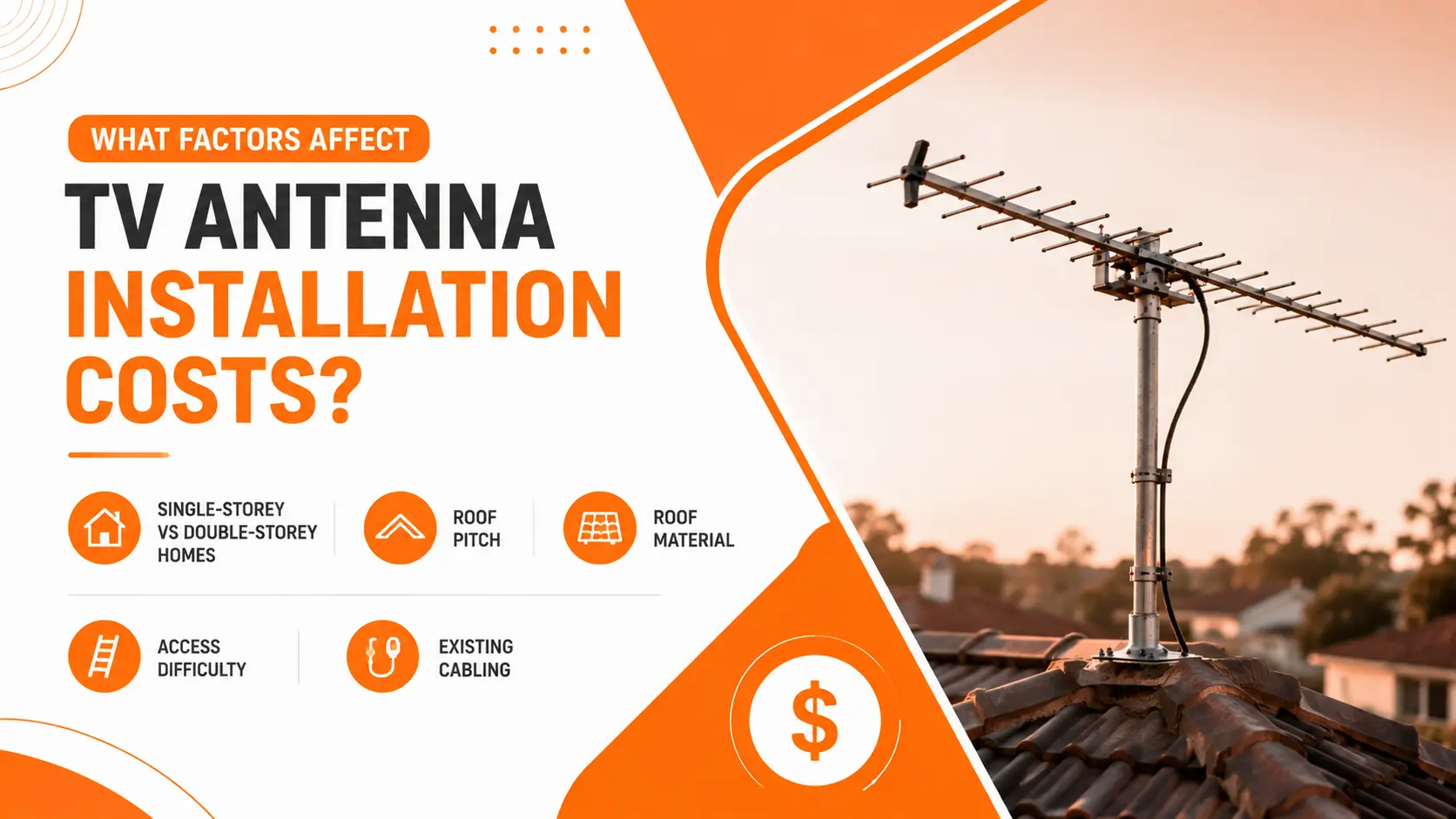
The biggest cost drivers are roof height and pitch, access difficulty, the condition of existing cabling, how many TVs need connecting, and whether extras like a signal booster or additional TV points come into it. Roof material and overall installation complexity matter too, since fragile or steep roofs simply take longer to work on safely. Most quotes end up shaped by two or three of these factors together, rather than any single one on its own.
Single-storey vs double-storey homes: A single-storey home with a simple gable roof is usually the quickest job going. Double-storey homes – especially older ones with steep pitches or multiple roof planes – take longer and often need extra safety equipment just to get up there safely. More height also means a longer cable run back down to the distribution point, which adds a bit more material and labour into the mix.
Roof pitch: A gentle pitch is easy to walk and easy to work on. Steeper pitches, common on the heritage-style rooflines through suburbs like Balmain or Leichhardt, slow things down and call for more caution, which naturally adds to time on site.
Roof material: Tile, colorbond steel, terracotta, and the asbestos-cement sheeting still found on plenty of older Sydney homes all behave differently underfoot. Fragile or ageing materials need a slower, more careful approach; rushing on brittle roofing is exactly how it gets damaged. Metal roofs bring their own quirk, too: a poorly earthed antenna mount on a colorbond roof can occasionally cause interference or hum on the line, so proper grounding is about more than just safety.
Access difficulty: Some properties are a straightforward, ground-level job. Others – narrow terraces in the Inner West with no side access, or homes on steep blocks with nowhere to park – take longer just to get equipment up there in the first place.
Existing cabling: Coaxial cabling that’s still in good condition can usually be reused, which helps keep costs down. Cabling that’s old, brittle, or was never installed to a proper standard, and we still come across runs stapled through gyprock or laid alongside power cables, which isn’t good practice, generally needs replacing rather than patching.
Older homes sometimes still have RG59 cable in the walls, which was fine for analogue TV but loses more signal over distance than the RG6 cable used today. On a long run out to a back bedroom, that difference alone can be the reason one TV in the house looks noticeably worse than the rest.
Signal testing: Every job starts with finding out what signal is actually reaching the property, and it’s not a box-ticking step. It tells us whether the problem’s the antenna, the cabling, the splitter, or genuine reception weakness in that particular pocket of Sydney. A signal meter reads in decibels, and having “enough” signal isn’t the whole story; too much can overload a TV tuner just as easily as too little can starve it. Both extremes throw up the same symptoms: pixelation, dropouts, or channels that simply won’t tune in.
Number of televisions: One TV is a simpler job than five. Multi-TV setups need splitters, sometimes amplification, and extra cable runs, which adds to both materials and labour time. Splitting a signal always costs you some strength; a two-way split loses a noticeable chunk, a four-way split more again, which is why a booster or masthead amplifier tends to become necessary once you’re feeding more than two or three points.
Extra TV points: Adding a point in a bedroom or home theatre room is a common request, especially alongside a renovation, and it’s usually priced as an add-on to the core installation. Worth flagging early if you’re planning one, because running cable before the walls close up is a very different job to fishing it through an existing cavity.
Signal boosters: A signal booster is a powered amplifier fitted to the antenna line to strengthen a weak signal before it’s split across multiple TVs. Properties further from the transmission towers, or sitting in a signal-shadowed spot, often benefit from one to keep the picture clean and stable across every outlet. The catch is that a booster amplifies whatever it’s given, interference included, so if the underlying problem is a damaged cable or a poor connection, bolting a booster on top can make things worse, not better. That’s why we always test first.
Antenna quality: Not every antenna’s built the same, and the right one depends on which transmitters and channels you’re actually pulling signal from:
| Antenna Type | Best Suited To | Note |
| UHF-only Yagi | Properties receiving all channels on the UHF band | The most common setup for modern Sydney installations |
| Combination VHF/UHF | Properties needing specific VHF-band channels | Less common today but still required in some reception areas |
| High-gain / extended | Fringe reception areas, further from transmitters | Better sensitivity, but more exposed to wind loading |
Element construction matters as well; cheaper antennas with painted or lower-grade aluminium elements tend to corrode faster in Sydney’s coastal air than better-built units. It’s one of the more common reasons an antenna only a few years old is already underperforming.
Installation complexity: Sometimes the job’s more than mounting a bracket and pointing it at a tower. Multi-dwelling properties, cable runs through several storeys, or tying into an existing home theatre setup all add time, and time is what drives cost in this trade.
New Installation vs Replacing an Existing Antenna
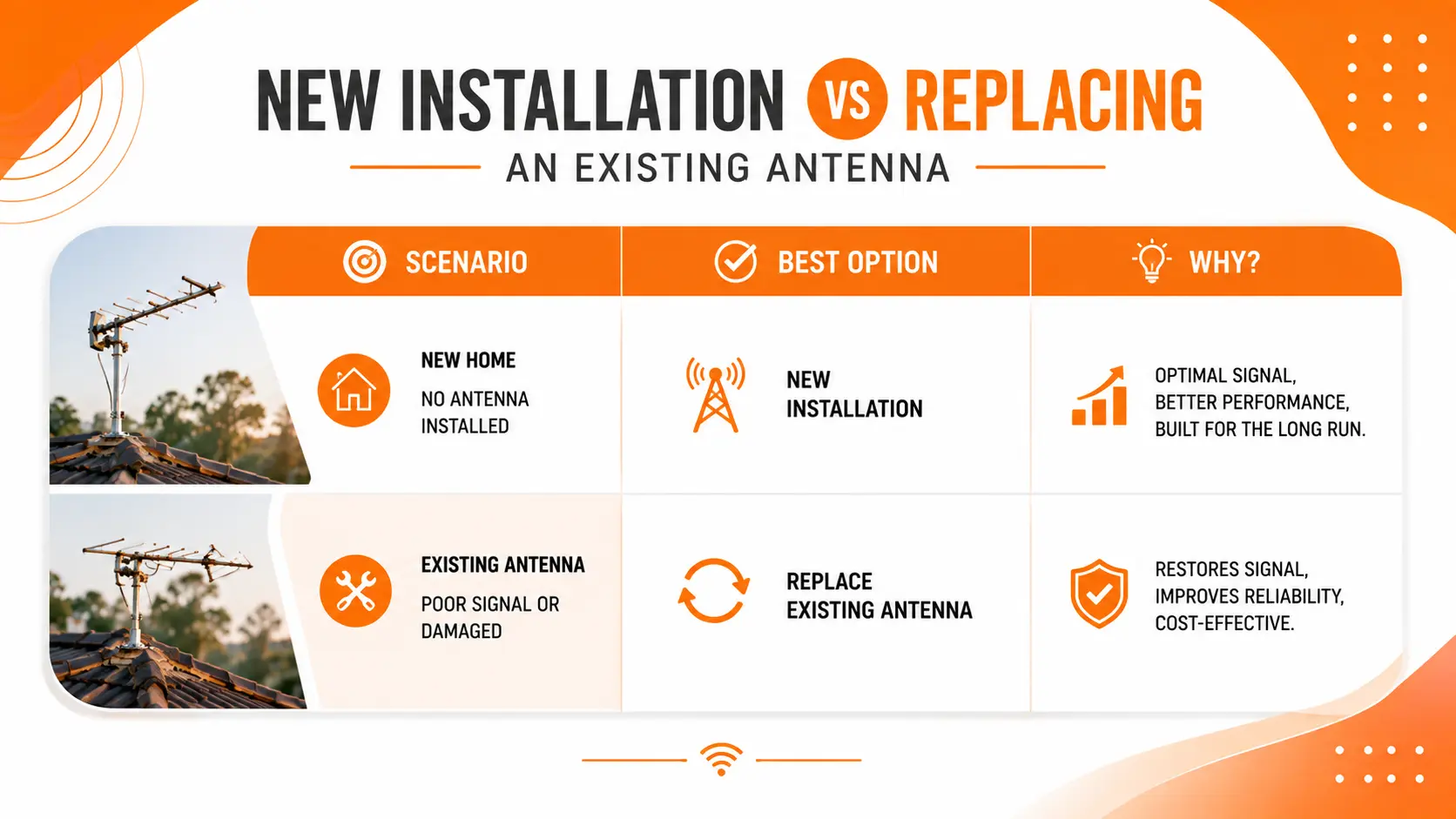
A new installation makes sense when there’s no working antenna to build on, or the existing system’s beyond a sensible repair. Replacement is generally the right call for antennas over 10–15 years old, especially where there’s visible corrosion or storm damage, while a repair is usually enough for a newer antenna with one isolated fault. Here’s how to tell which situation applies to you.
| Scenario | Best Option | Why |
| No antenna currently installed | New installation | Starting fresh means the whole system – antenna, cabling, mount – is fitted to current standards |
| Antenna over 10–15 years old, corroded or storm-damaged | Replacement | Older antennas degrade, especially given Sydney’s coastal air and storm exposure |
| Antenna is sound, but reception is patchy | Repair or signal test first | The antenna itself may be fine; the real cause could be cabling, alignment, or a faulty connection |
| Recent antenna with a specific fault (loose wall plate, damaged lead) | Repair | There’s no need to replace a working system over one faulty part |
| Renovating or adding a second storey | New installation likely needed | Structural changes usually mean repositioning or upgrading the antenna and cabling anyway |
A full new TV antenna installation is worth it when there’s genuinely nothing usable to build on, or the existing system’s past its working life. But plenty of homeowners assume replacement is the only option when a targeted repair would do the job just as well, and that’s exactly where the next section comes in.
Can an Existing TV Antenna Be Repaired Instead?
In most cases, yes. Most reception complaints come down to a specific, fixable fault. A loose connection, a damaged cable, corrosion, or misalignment, rather than a genuinely dead antenna. A proper signal test is the fastest way to tell the difference, and it’s the step that stops homeowners paying for a full replacement when the fix was far smaller.
What looks like “the antenna’s dead” usually turns out to be one of a handful of specific, fixable faults. A technician working through a reception complaint will typically check these in roughly this order, from most to least common:
- Loose connections at the antenna, wall plate, or splitter are a surprisingly common cause of intermittent dropouts. F-connectors that were never tightened properly, or ones that have simply worked loose over years of roof expansion and contraction in the heat, are one of the first things worth checking.
- Damaged coaxial cables, often pinched, chewed by rodents in the roof cavity, or degraded from long-term UV exposure where a cable’s been run externally without proper conduit.
- Water ingress into connectors or the antenna’s internal components, typically after heavy rain or a storm. We see plenty of this after Sydney’s wetter stretches; moisture gets into a connector, kicks off a slow corrosion process, and the picture gets progressively worse over weeks rather than dying all at once.
- Corrosion, particularly in coastal suburbs where salt air eats into metal fittings over time. Rarely dramatic, usually a gradual decline in picture quality that homeowners chalk up to “the weather” long before realising it’s the hardware.
- Storm damage, a genuine recurring issue in Sydney given how often severe weather rolls through over summer. A near-miss lightning strike or a strong wind gust can knock an antenna out of alignment without any obvious physical damage, so a perfectly straight-looking antenna isn’t always the whole story.
- Faulty wall plates, which can look fine on the outside while having failed internally.
- Poor alignment, where the antenna’s shifted slightly and no longer points cleanly at the transmission towers. A UHF antenna’s reception pattern is fairly narrow, so even a small shift, sometimes just a few centimetres at the mast, can drop a strong signal down to an unreliable one.
A proper TV antenna repair assessment should always come before anyone commits to a full replacement. A professional signal test tells you what’s actually wrong instead of leaving it to guesswork, and it can spare you the cost of a new antenna when the real fault was something far smaller.
What’s Usually Included in a Professional Installation?
A professional TV antenna installation typically includes a site assessment, signal testing before and after the work, secure mounting and earthing, cabling checks, channel tuning, and a final reception test across every connected TV. These steps confirm the whole system, not just the antenna itself, is delivering a stable, compliant signal by the time the installer packs up.
Standard industry practice for a proper installation generally covers:
- Site assessment – checking the roof, existing cabling, and the clearest line of sight to relevant transmission towers
- Signal testing – carried out both before and after installation, to confirm what’s actually being received, in decibels rather than a rough guess
- Secure mounting – fitting the antenna and mast to withstand Sydney’s weather, including wind gusts and storms, with proper earthing where the roof type calls for it
- Cable checks – inspecting existing runs, or installing new cabling to a proper standard where needed
- Channel tuning – making sure your TVs are correctly tuned once the antenna’s connected, picking up the full range of free-to-air multiplexes available in your area
- Reception testing – confirming a stable signal across every connected point, not just the nearest TV
- Safety compliance – working at height with appropriate equipment and precautions
Every installer’s process looks a bit different in the details, but these steps are what’s genuinely standard across the trade, not a list dressed up for marketing.
How to Get an Accurate Quote
An accurate quote comes down to how much detail you give the installer before they show up. Your suburb, property type, number of TVs, the age and condition of any existing antenna, and a clear description of the reception issue all help narrow down the likely cause and scope of work in advance.
Photos of the roof and any visible cabling speed things up further, since they let an installer spot obvious issues before ever picking up a ladder.
Have the following ready before you make contact:
- Your suburb – signal strength and transmission direction vary across Sydney
- Property type – house, townhouse, or apartment, and whether it’s single or double storey
- Number of televisions you want connected
- Photos of your roof, existing antenna, and any visible cabling
- Details of your existing antenna, if you have one: its age, condition, and any obvious damage
- The specific issue you’re experiencing – no signal at all, dropouts during weather, pixelation, or particular channels missing
That last point matters more than it sounds. What the symptom looks like often points an installer toward the likely cause before they’ve even seen the roof:
| Symptom | Likely Cause |
| Dropouts only during wind or rain | Loose connection or water ingress |
| Some channels missing, others fine | Antenna misalignment |
| Gradual decline in picture quality over weeks | Corrosion in connectors or fittings |
| Sudden total loss of signal | Cable damage, storm impact, or a dislodged antenna |
| Poor reception on far-from-antenna TVs only | Cable run length or a bad splitter |
Hand this detail over upfront, and you’ll get a genuine assessment, not a generic figure that falls apart the moment someone’s actually on site.
Common Mistakes Homeowners Make
The most common mistakes are picking the cheapest quote without checking what’s included, replacing an antenna before it’s actually been tested, and ignoring damaged cabling because the antenna itself looks fine.
DIY installs without the right earthing or signal-testing gear, and buying an antenna that doesn’t suit the property’s distance from the transmitter, round out the list. Most of these come down to treating the antenna as the whole system, when cabling, connections, and alignment matter just as much.
- Choosing the cheapest quote without checking what’s included: A low price sometimes means shortcuts on cabling quality, mounting hardware, or aftercare, rather than genuine value.
- Replacing an antenna without testing it first: We’ve turned up to jobs booked as “install a new antenna” and found the existing one was perfectly fine; the actual fault was one damaged connector.
- Ignoring damaged cabling: A brand-new antenna wired into old, corroded cabling will still hand you a poor picture. The antenna’s only ever half the system, and a technician will always check both ends of the run before signing off.
- DIY installations without proper equipment: Roof work carries real risk, and an antenna that’s poorly grounded or badly aligned can leave you with reception problems that outlast the effort of putting it up yourself. We’ve also seen DIY jobs where the coax was run alongside mains power cabling in the roof, which can introduce interference that’s genuinely tricky to diagnose later, because the symptoms look identical to a weak signal.
- Buying the wrong antenna for the area: Not every antenna suits every location. Get the type wrong for your distance from the transmitter or your surrounding terrain, and you’re stuck with a permanently weak signal that no amount of fiddling will fix.
Final Thoughts
There’s no single figure that applies to every home when it comes to TV antenna installation cost in Sydney, and any installer prepared to quote sight unseen is really just guessing. What actually sets the price is your property, what’s already installed, and the condition it’s all in.
If you’re not sure whether you’re looking at a simple repair, a full replacement, or something in between, the most reliable next step is a proper on-site assessment. It saves you paying for work you don’t need and gives you a clear, accurate picture of what your home actually requires, whether that’s a TV antenna installation, a signal booster installation, extra TV points, TV wall mounting, or straightforward digital TV reception repairs.
Frequently Asked Questions (FAQs)
Here are the questions Sydney homeowners ask us most often about antenna installation, repair, and reception. Each answer reflects standard industry practice rather than a hard-and-fast rule, since the right approach still depends on your specific property and existing setup.