
If you live anywhere from North Sydney and the Lower North Shore through Manly, Dee Why, Narrabeen, Mona Vale, Newport, Avalon and Palm Beach, you may have experienced the same frustrating problem: the TV works perfectly one day, then starts pixelating, freezing or losing channels the next.
The good news is that difficult TV reception can usually be investigated systematically. The important thing to understand is that there is no single antenna setup that works for every property across the Northern Beaches. Reception depends on the property’s position, elevation, surrounding terrain, the transmission site being used, antenna type, polarisation, cabling and the quality of the incoming signal.
At Fix TV Antenna, we often find that two houses in the same suburb can have completely different reception. One property may have a clear path to a transmitter, while the next property may sit behind a ridge, building or trees. That is why a proper antenna installation starts with testing rather than guesswork.
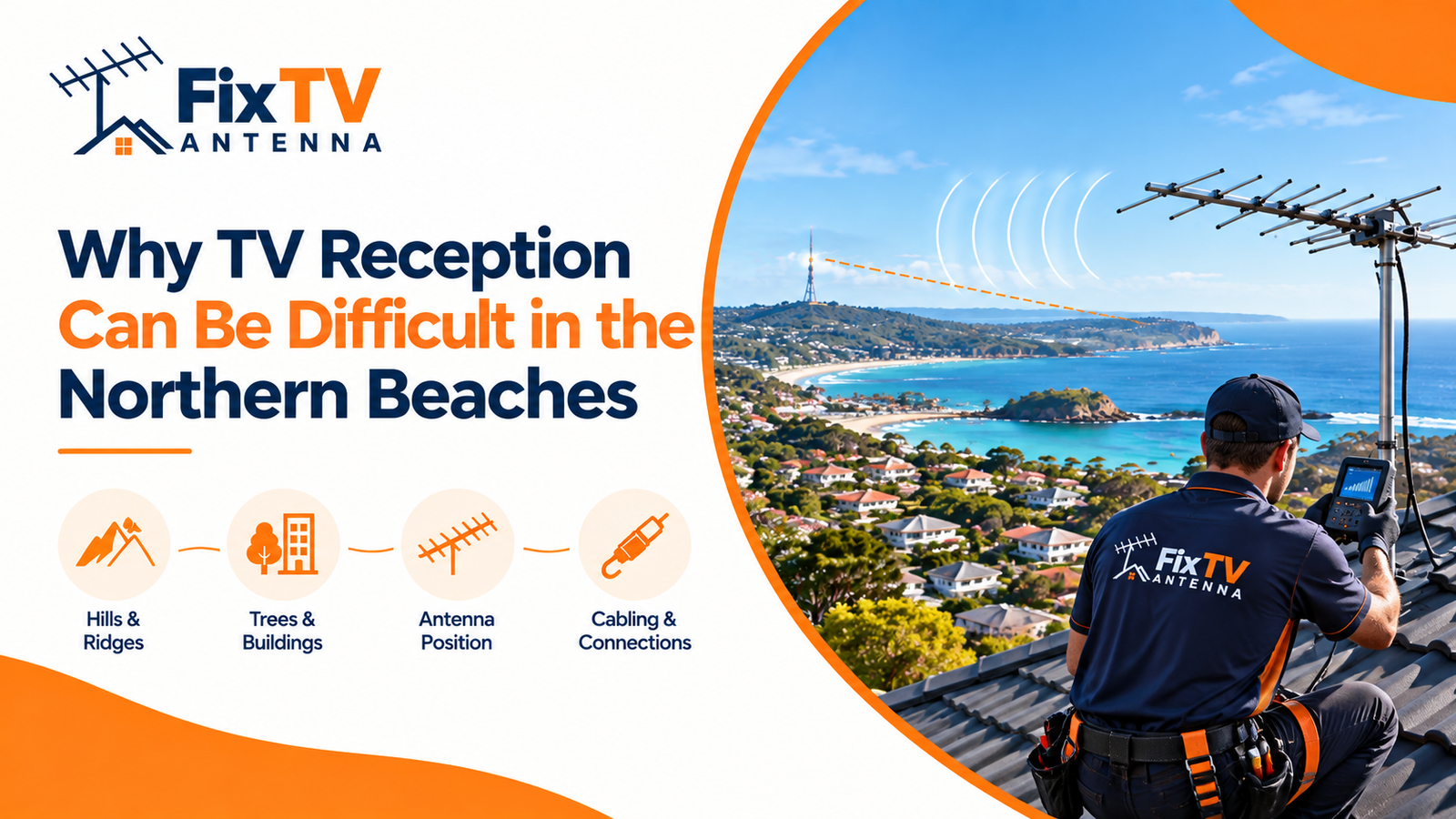
Why TV Reception Can Be Challenging in the Northern Beaches
The Northern Beaches is a particularly interesting area for TV reception because of its coastal geography. There are hills, ridges, valleys, beaches, headlands, dense vegetation and many different property elevations. The peninsula also contains areas where a property may have a very different signal path from another property only a few streets away.
- Hills and ridges can block the direct path to a transmitter.
- Trees and vegetation can interfere with an already marginal signal, particularly when they move in strong wind.
- Buildings and apartment blocks can obstruct or reflect the signal.
- Properties at different elevations can have very different reception conditions.
- Different transmission sites use different frequencies and polarisation.
- Older antennas, splitters, connectors and coaxial cable can deteriorate over time.
- Coastal exposure can accelerate corrosion of outdoor antenna components and connections.
The Main Transmission Sites Relevant to Northern Sydney and the Northern Beaches
The transmission site that works best for one property is not necessarily the best site for another. The following sites are important when assessing reception across the wider Northern Beaches and northern Sydney region.
Artarmon – Sydney Main Transmission Site
The Artarmon site is a major Sydney transmission site and carries the main Sydney VHF television services. TXA lists services on channels 6, 7, 8, 11 and 12, with horizontal polarisation. For many properties around the Lower North Shore and nearby areas, the signal path towards the main Sydney transmission infrastructure is important.
North Head / Manly
The North Head site at Manly is particularly relevant to the Northern Beaches. TXA lists digital services on UHF channels 28 to 33, using horizontal polarisation. Because the site is within the Northern Beaches, it can provide an important transmission path for properties around Manly and surrounding suburbs.
Bouddi
Bouddi is an important northern transmission site. TXA lists its main services on UHF channels 40 to 44 and notes vertical polarisation. For some northern-facing properties, this can be a relevant transmission path.
Wyrrabalong / Forresters Beach
Further north, the Wyrrabalong site at Forresters Beach becomes relevant to the wider Central Coast and northern areas. TXA lists UHF services including channels 40 to 48, with vertical polarisation.
Gosford
The Gosford transmission site is another Central Coast site that may be relevant depending on the property and its terrain. Its listed UHF services use horizontal polarisation.
Important: A suburb should never be treated as proof of which transmitter a property must use. The exact address, antenna height, terrain and measured signal determine the practical installation.
Northern Beaches Suburbs – Why the Same Rule Does Not Apply Everywhere
The following suburb groups are useful as a guide, but they are not fixed transmitter maps. Within every group, individual properties can have different reception because of terrain and line of sight.
North Sydney & Lower North Shore
North Sydney, Kirribilli, Neutral Bay, Kurraba Point, Cremorne, Cremorne Point, Mosman, The Spit, Cammeray, Willoughby, Castle Cove, Castlecrag, Middle Cove, Northbridge, Naremburn, Crows Nest, St Leonards, Artarmon and Chatswood.
Many properties in this area are associated with the main Sydney transmission infrastructure around Artarmon, but buildings, ridges and local terrain can alter the actual signal.
Manly & Surrounding Suburbs
Manly, Fairlight, Balgowlah, Balgowlah Heights, North Balgowlah, Seaforth, Manly Vale, Clontarf, Allambie Heights, Brookvale, North Manly, Freshwater, Queenscliff and Curl Curl.
North Head can be an important transmission path, while some properties may receive a stronger signal from the main Sydney sites. Elevation and the direction of the property are critical.
Dee Why, Cromer & Northern Inland Beaches
Dee Why, North Curl Curl, Cromer, Cromer Heights, Narraweena, Wheeler Heights, Beacon Hill, Brookvale, Frenchs Forest and Allambie Heights.
The hills and ridges in this area mean that reception can change significantly from street to street. Antenna height and line of sight can become particularly important.
Narrabeen, Warriewood & Mona Vale
Narrabeen, North Narrabeen, Warriewood, Ingleside, Mona Vale, Bayview, Church Point, Elanora Heights, Terrey Hills and Duffys Forest.
These areas can have very different reception paths. Some properties may receive a strong signal from Sydney/Manly, while others may have a better path towards a northern UHF transmission site.
Newport, Bilgola, Avalon & Palm Beach
Newport, Bilgola, Bilgola Plateau, Avalon, Avalon Beach, Clareville, Careel Bay, Paradise Beach, Whale Beach and Palm Beach.
The peninsula’s hills, valleys and headlands make line of sight particularly important. Some properties may require a different antenna type, direction or polarisation from nearby homes.
It All Comes Down to Line of Sight
One of the most important concepts in TV antenna work is line of sight. The signal has to travel from the transmission site to the receiving antenna. Anything that significantly obstructs, reflects or weakens that path can affect reception.
- A hill or ridge between the property and transmitter.
- Large trees or dense vegetation.
- High-rise buildings or neighbouring structures.
- A roof position that sits below the surrounding terrain.
- An antenna installed too low to clear a local obstruction.
- Reflections caused by nearby buildings or terrain.
This is why one house can have excellent reception while another house nearby has pixelation. The distance to the transmitter is only part of the story. The quality of the signal path is often more important.
Does Living Near the Ocean Affect TV Antenna Reception?
Living close to the water does not mean that TV signals are simply absorbed by salty seawater. However, coastal properties are exposed to salty, humid air, and that environment can be hard on outdoor antenna equipment.
- Antenna elements can corrode over time.
- F-connectors and other metal connections can deteriorate.
- Outdoor splitters and amplifiers can be affected by moisture and corrosion.
- Coaxial cable connections can become unreliable if they are not properly sealed.
- Mast and mounting hardware can rust, particularly where protective coatings have deteriorated.
So, for a coastal property, the water itself is not normally the direct cause of weak TV reception. The bigger concern is the long-term effect of salt and moisture on the equipment and connections.
Why Does the TV Pixelate When It Rains or Gets Windy?
When a customer says, ‘It only happens when it rains or the wind picks up,’ there may already be an underlying reception problem.
- Wind can move trees across the signal path.
- A marginal signal can become unstable when environmental conditions change.
- Water can expose problems with damaged cable or poorly sealed connections.
- A loose antenna or mast can move slightly in strong wind.
- Corroded connections can become more unreliable when wet.
Rain or wind is therefore not always the root cause. It can simply expose a system that was already operating close to its reception limit.
Why a Bigger Amplifier Is Not Always the Answer
A common assumption is that weak TV reception should always be fixed by adding a stronger amplifier. That is not necessarily correct.
Digital television needs both adequate signal level and good signal quality. If the incoming signal is already strong but distorted, noisy or affected by interference, more amplification will not necessarily improve the picture. In some installations, excessive signal can overload equipment and make reception worse.
This is why signal measurements should be taken before choosing an amplifier. Sometimes the solution is amplification; sometimes it is attenuation, a different antenna, better cabling, a different antenna position or correction of a faulty component.
VHF or UHF – Which Antenna Does a Northern Beaches Property Need?
There is no single antenna type that should automatically be installed across the entire Northern Beaches.
The Artarmon site uses VHF services, while North Head, Bouddi and Wyrrabalong use UHF services. The transmission characteristics, frequency range and polarisation therefore need to be considered when selecting and aligning an antenna.
- VHF antenna
- UHF antenna
- Combination antenna
- High-gain antenna where appropriate
- Different antenna polarisation
- Mast-head amplifier where measurements justify it
- Distribution amplifier for larger systems
- Attenuation where signal levels are excessive
What a Professional Antenna Technician Should Test
- Signal strength – how much signal is arriving at the antenna and outlets.
- Signal quality – whether the digital signal is clean and stable.
- MER – an important measurement of digital signal quality.
- BER – useful for identifying reception errors.
- Individual channel/multiplex performance.
- Antenna direction and polarisation.
- Coaxial cable condition and losses.
- F-connectors, splitters and wall plates.
- Amplifiers and power supplies.
- The physical line of sight to the likely transmission site.
Common TV Antenna Problems We See in the Northern Beaches
- Pixelation and picture freezing
- Channels disappearing intermittently
- Channel 7, 9, 10, ABC or SBS reception problems
- Reception that fails during rain or wind
- Corroded antenna connections
- Rusted or damaged splitters
- Water-affected coaxial cable
- Faulty amplifiers or power supplies
- Excessive signal levels
- Incorrect antenna direction
- Incorrect polarisation
- Trees or buildings affecting line of sight
- Old or unsuitable antenna systems
Practical Solutions
Once the cause has been identified, the solution may be straightforward or may involve several parts of the antenna system.
- Replace an old, damaged or unsuitable antenna.
- Align the antenna with the most suitable transmission source.
- Use the correct polarisation for that transmission path.
- Raise or relocate the antenna where a local obstruction is affecting line of sight.
- Replace damaged or water-affected coaxial cable.
- Replace corroded connectors, splitters or wall plates.
- Repair or replace a faulty amplifier or power supply.
- Install amplification only when the measured signal requires it.
- Use attenuation when signal levels are excessive.
- Improve the distribution system for multi-TV homes, apartments or strata properties.
The Right Antenna Is About the Property – Not Just the Suburb
A house in Manly may need a different antenna arrangement from another house in Manly. A property in Avalon may need a different solution from a property only a few streets away. Even two neighbouring homes can have different results because their roof height, orientation, surrounding buildings and line of sight are different.
That is why a good antenna installation should be based on measured signal conditions at the property rather than simply installing the same antenna everywhere.
Fix TV Antenna – Northern Beaches TV Antenna Installation & Repair
Fix TV Antenna provides TV antenna installation, repair and reception troubleshooting across the Northern Beaches and surrounding northern Sydney areas.
We service North Sydney, Neutral Bay, Mosman, Cremorne, Manly, Fairlight, Balgowlah, Seaforth, Manly Vale, Freshwater, Queenscliff, Curl Curl, Dee Why, Narraweena, Cromer, Beacon Hill, Allambie Heights, Frenchs Forest, Narrabeen, North Narrabeen, Warriewood, Mona Vale, Bayview, Terrey Hills, Ingleside, Newport, Bilgola, Avalon, Clareville, Whale Beach, Palm Beach and surrounding areas.
If your TV is pixelating, losing channels or dropping out in windy or wet weather, the television itself may not be the problem. The cause could be the antenna, cable, connector, splitter, amplifier, antenna direction, polarisation, local terrain or line of sight.
At Fix TV Antenna, we focus on finding the cause first and then recommending the appropriate solution for the property.
TV reception is location-specific. The best antenna installation is based on the signal path and the property—not simply the suburb.
Technical Reference
Transmission information referenced in this article is based on TXA’s Sydney and transmission-site information. Actual reception at an individual property can differ because of terrain, buildings, vegetation, antenna installation and local conditions.